
Why Serbian and Croatian Look Identical — Until They Don't
Serbian and Croatian share almost all their grammar and most of their vocabulary, yet order 'bread' with the wrong word and everyone knows where you learned it. Here's where the two languages actually split.
 Slavonaut4 min read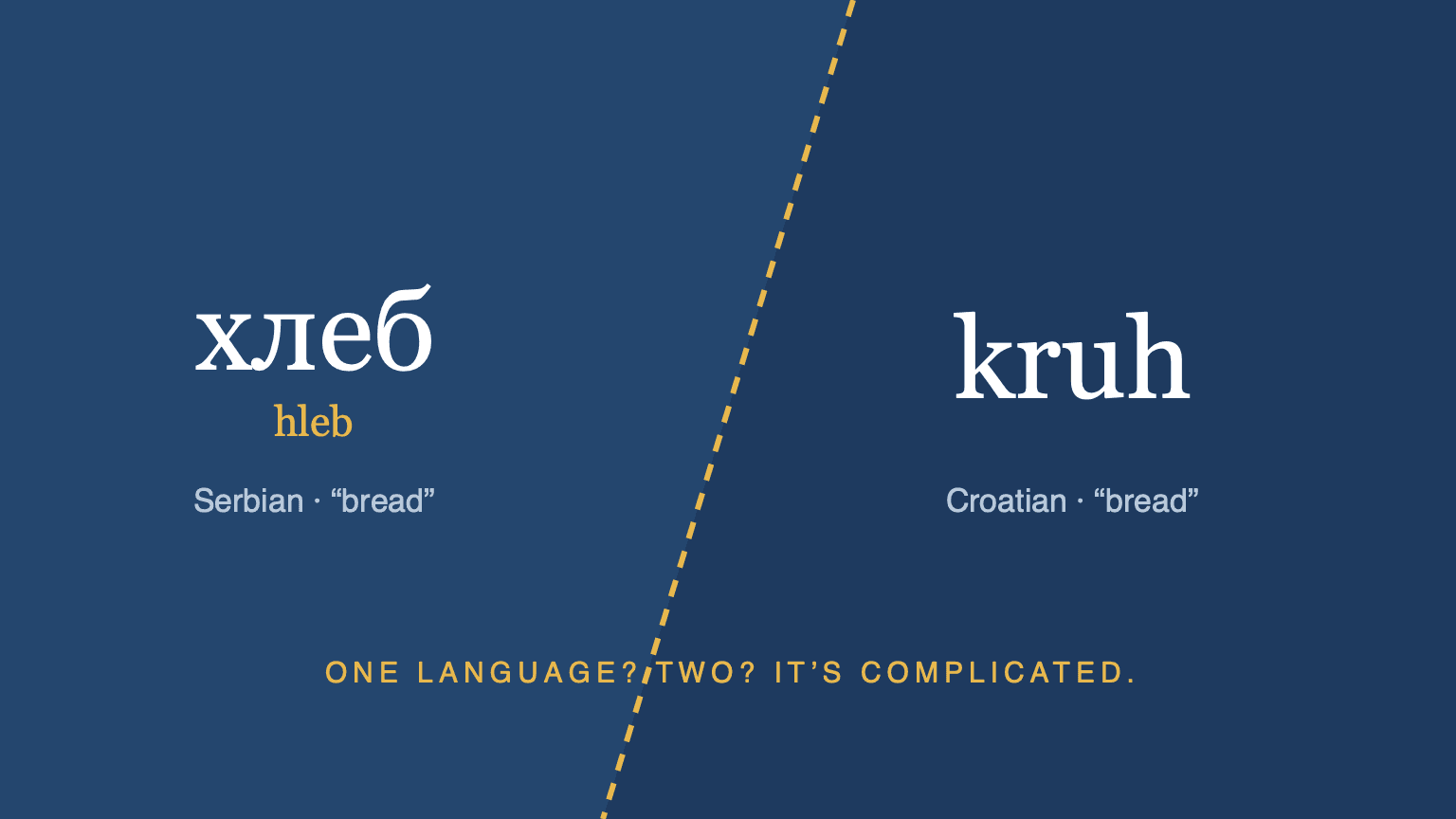
On this page▾
Ask a linguist whether Serbian and Croatian are the same language and you'll get a careful cough and a twenty-minute answer. Ask a Serb or a Croat and you'll get a much shorter answer, delivered with feeling — and it will be a different answer depending on which one you asked.
Here's the honest version: a Serbian speaker and a Croatian speaker can watch the same film, argue about it afterwards, and never reach for a dictionary. Mutual intelligibility is somewhere north of 95%. And yet the two standards diverge in ways that are systematic, learnable, and occasionally hilarious. If you're deciding which one to learn, or you've learned one and want to "unlock" the other, this is the map.
The same skeleton
Start with what's shared, because it's almost everything. Serbian and Croatian have the same seven cases, the same verb aspect system, the same three genders, and essentially the same word order logic. They descend from the same dialect — Neo-Štokavian — which is why the grammar feels like one system wearing two flags.
That has a practical consequence for learners: everything you learn in one is about 95% transferable to the other. Learn the Serbian beginner path and you can read a Zagreb café menu; learn the Croatian one and Belgrade street signs will mostly cooperate — once you handle the first big difference.
Difference #1: the alphabet situation
Croatian uses the Latin alphabet. Full stop.
Serbian uses both — Cyrillic is official, but Latin is everywhere in daily life. A Belgrade newspaper might be in Cyrillic while the billboard next to the kiosk selling it is in Latin. Serbians switch between scripts mid-day without noticing, the way you switch between typing and handwriting.
The two scripts map to each other one-to-one, so this is less scary than it looks: с↔s, р↔r, ш↔š, and so on down the line. Our Serbian language guide has the full table. Learn it in an afternoon; feel smug forever.
Difference #2: ekavian vs. ijekavian
One ancient vowel — the Proto-Slavic yat — split the dialects like a fault line. Where Serbian standard usually has e, Croatian has ije or je:
| Serbian | Croatian | meaning |
|---|---|---|
| mleko | mlijeko | milk |
| lepo | lijepo | beautifully |
| reka | rijeka | river |
That last one is why Croatia has a whole city named Rijeka — literally, "River."
This is the single most reliable "which standard is this?" tell, and it's wonderfully regular: once you know the pattern, you can convert most words in your head. (Bosnian and Montenegrin standards are ijekavian too, which is why your Sarajevo friend sounds "Croatian" to your Belgrade friend. Do not start this conversation at dinner.)
Difference #3: the vocabulary cold war
Here's where it gets fun. For a chunk of everyday vocabulary, the two standards simply picked different words — Croatian often preferring Slavic coinages, Serbian more relaxed about international loanwords:
| Serbian | Croatian | meaning |
|---|---|---|
| hleb | kruh | bread |
| voz | vlak | train |
| pozorište | kazalište | theatre |
| univerzitet | sveučilište | university |
Croatian sveučilište is literally "all-learning-place" — the language built its own word rather than borrow universitas. Serbian shrugged and took the loan. Neither is wrong; both are proud of it.
The good news: these pairs are finite, they're the kind of thing our dictionary flags, and locals will understand you either way. The worst that happens is someone grins and asks if you learned "the other one." (For words that look identical across Slavic languages but mean different things — a much more dangerous category — see false friends.)
Difference #4: da or not to da
One genuinely structural split: what to do with "want to" + verb. Serbian loves the da + present construction; Croatian prefers a clean infinitive:
- Serbian: Želim da idem — "I want that I go"
- Croatian: Želim ići — "I want to go"
Both are grammatical everywhere; the preference is the accent. If you write želim da idem in a Zagreb essay, a red pen will find it.
So… one language or two?
Linguistically, it's one pluricentric language with multiple standards — like English in London, Delhi, and Chicago, if each of those cities had its own army and very strong opinions. Politically and culturally, they're distinct languages, and people's feelings about that are real and worth respecting.
For a learner, though, the takeaway is pure profit: learn one, get the other at a 95% discount. Slavonaut treats them as siblings — separate Serbian and Croatian guides, separate beginner paths, one shared dictionary with both variants marked — so you can start with either and switch scripts, vowels, and bread-words whenever you're ready.
Start with Serbian if Cyrillic excites you and you like your vowels efficient. Start with Croatian if you're headed for the coast. Either way, you're learning both — one of them just doesn't know it yet.