
Polish Digraphs Explained: Master sz, cz, rz, and ch
Struggling with Polish spelling? Learn the simple rules behind Polish digraphs (sz, cz, rz) and discover why Polish consonant clusters are easier than they look.
 Slavonaut10 min read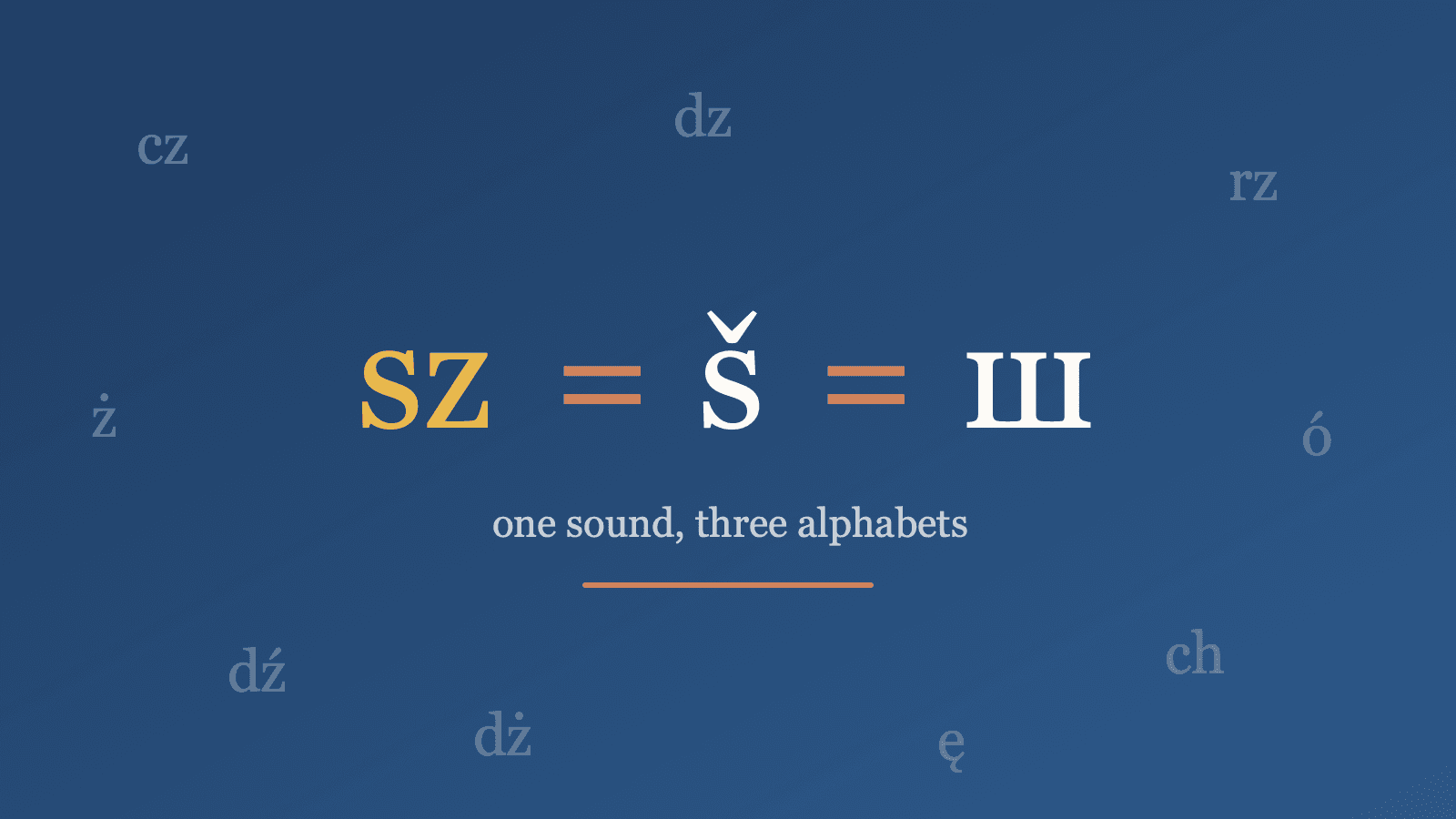
On this page▾
If you have ever looked at a Polish newspaper, a street sign in Warsaw, or a menu at a milk bar, you might have felt a sudden sense of panic. Words like szczęście (happiness) or chrząszcz (beetle) look less like human language and more like the result of a cat walking across a keyboard.
It is a running joke among language learners that the Polish alphabet is just a handful of vowels drowning in a sea of z's. But what if I told you that Polish spelling is actually highly logical, remarkably consistent, and completely manageable once you know the secret code?
The illusion of the "impossible consonant cluster" comes down to one simple concept: digraphs.
English uses digraphs all the time. Think of the word thought. It has seven letters but only three sounds (th-ough-t). When you see sh in shoe or ch in chair, you don't try to pronounce the s and the h separately. You instantly recognize them as a single sound.
Polish is doing the exact same thing. It just uses different combinations of letters.
In this guide, we are going to demystify Polish digraphs. We will look at exactly how to pronounce them, uncover the fascinating historical reasons why Polish looks the way it does, and show you how comparing Polish to other Slavic languages like Russian, Czech, or Croatian makes these intimidating words surprisingly easy to read. (For the full story of why Polish ended up spelled this way, see Why Polish Looks Impossible — this article is the practical field guide.)
What Is a Digraph?
A digraph is simply a combination of two letters that represent one single sound (a phoneme).
When the earliest Polish writers tried to write down their language, they ran into a massive technical problem. The Latin alphabet only had 23 letters. Old Polish, however, was a Slavic language with a rich, complex phonetic inventory of nearly 40 distinct sounds — including a wide variety of hisses, hushes, and buzzes.
There was a serious "hardware mismatch."
To solve this, they had to improvise. Instead of inventing entirely new letters, they combined existing Latin letters to represent the unique Slavic sounds.
The Core Polish Digraphs
There are seven primary digraphs in Polish. Once your brain learns to treat these pairs as single letters, reading Polish becomes incredibly smooth.
1. SZ (the hard "sh")
How to pronounce it: very close to the English sh in show or ship. (Technically, the Polish sound is "retroflex," meaning the tip of your tongue is curled slightly further back in your mouth than in English, giving it a slightly deeper, harder sound.)
Slavic comparison: if you have studied any other Slavic languages, sz is the exact equivalent of the Cyrillic letter Ш (in Russian, Ukrainian, Serbian, or Bulgarian) and the Latin letter Š (in Czech, Slovak, or Croatian).
| Meaning | Polish | Russian | Czech |
|---|---|---|---|
| school | szkoła | школа | škola |
2. CZ (the hard "ch")
How to pronounce it: the equivalent of the English ch in chat or chocolate. Just like sz, it is slightly harder and deeper than the English version.
Slavic comparison: this maps perfectly to the Cyrillic letter Ч and the Czech/Croatian letter Č.
- Polish: czas (time)
- Russian: час (chas)
- Croatian: čas (moment)
3. RZ (the buzzing non-R)
How to pronounce it: this one terrifies beginners because it has an r in it, but you do not roll the R. In modern Polish, rz sounds exactly like the s in the English word measure or the g in mirage.
Wait — if it sounds like a buzzing 'zh', why is it spelled with an R?
Slavic comparison: because rz evolved from a soft r, looking at other Slavic languages is a massive cheat code for spelling in Polish. Where Polish has rz, Russian almost always has an r (р) and Czech has an ř.
| Meaning | Polish | Russian | Czech | Croatian |
|---|---|---|---|---|
| river | rzeka | река | řeka | rijeka |
4. DZ (the "ds" buzz)
How to pronounce it: this is simply a d and a z pronounced at the exact same time. It sounds like the ds in the English word pads or woods.
- Example: dzwon (bell)
5. DŻ (the hard "j")
How to pronounce it: this is the voiced partner of cz. It sounds exactly like the English j in jam or jump. It is quite rare in Polish and is mostly found in loanwords or very specific roots.
Slavic comparison: this corresponds to the Cyrillic digraph дж (used in Ukrainian and Bulgarian) and the letter Dž in Croatian and Serbian.
- Polish: dżem (jam)
- Serbian: џем / džem
6. DŹ (the soft "j")
How to pronounce it: a very soft j sound. Imagine saying the j in jeep, but push the middle of your tongue up against the roof of your mouth. It sounds incredibly soft, light, and almost "hiss-like."
Slavic comparison: this sound is very close to the Serbian/Croatian Đ (đ) or the Russian soft Дь.
- Polish: niedźwiedź (bear)
- Russian: медведь (medved')
7. CH (the throaty "h")
How to pronounce it: the classic guttural sound found in the Scottish word loch, the German name Bach, or the Spanish jalapeño. It is a strong h sound produced in the back of the throat.
Slavic comparison: this corresponds perfectly to the Cyrillic letter Х and the Croatian/Czech letter H (or ch in Czech).
- Polish: chleb (bread)
- Russian: хлеб (khleb)
- Croatian: hleb
The Trigraph: DZI
If two letters weren't enough, Polish occasionally uses three letters to make a single sound. The most common is dzi.
When the digraph dz is followed by an i, it becomes palatalized (softened). The pronunciation is completely identical to the digraph dź we learned above.
Why two different spellings for the same soft sound? It depends on what letter comes next:
- If the sound is at the end of a word or followed by a consonant, use dź (e.g., dźwięk — sound).
- If the sound is followed by a vowel, use dzi (e.g., dzień — day).
The Great Spelling Bee Nightmares: CH vs. H and RZ vs. Ż
If you have been paying close attention, you might have noticed a diabolical problem with the Polish alphabet.
- ch and h are pronounced exactly the same in modern Polish (both sound like a strong, raspy 'h').
- rz and ż are pronounced exactly the same (both sound like the 's' in measure).
- ó and u are pronounced exactly the same (both sound like the 'oo' in boot).
Why on earth would a language have two different ways to spell the exact same sound?
How to know which one to use?
For a language learner, this seems like a nightmare. How do you know whether to write morze (sea) or może (maybe)? They sound completely identical!
Here is where studying other Slavic languages — or just paying attention to Polish word roots — gives you superpowers.
The RZ / Ż rule: because rz evolved from an r, it will almost always change back into a regular r in related words.
- morze (sea) → morski (maritime). The rz switches to r — that tells you it must be spelled with rz, not ż.
- lekarz (doctor) → lekarstwa (medicines).
- If you know Russian, you know the Russian word for sea is море. The presence of the r in Russian guarantees the Polish spelling will be rz.
The CH / H rule: because ch is a traditional Slavic sound, and h was mostly introduced through foreign loanwords, you can often guess the spelling based on the word's origin.
- If it's a native, earthy Slavic word, it's probably ch (chleb — bread, mucha — fly).
- If it's a loanword from Greek, Latin, or English, it's probably h (historia, helikopter, herbata — tea, borrowed from Latin herba).
Taming the Consonant Clusters
Now that you know what the digraphs are, how do you actually read words like Szczecin or chrząszcz without passing out?
1. Use the "chunking" method
When you look at a Polish word, do not read it letter by letter. Your brain will panic seeing s-z-c-z. Instead, take a pencil (mental or physical) and draw a line under the digraphs.
Look at the word szczęście (happiness).
- Underline the digraphs: sz - cz - ę - ś - c - i - e.
- Suddenly, it's not a 9-letter monster. It is a word of a few clean sounds: [sh] - [ch] - [en] - [soft sh] - [ch-ee] - [e].
2. Visualize the Czech alphabet
If you are struggling with reading speed, pretend you are reading Czech. When you see sz, force your brain to see š. When you see cz, see č.
Let's convert a terrifying word into "Czech" formatting:
- Polish spelling: Szczecin (a city in Poland)
- Mental translation: Ščecin
- Look how much friendlier that is! It's just "Sh-che-tsin."
3. Trust the vowels
A common misconception is that Polish words don't have vowels. They do! They are just visually suffocated by the digraphs. Every Polish syllable must have a vowel. If you get lost in a word, find the vowels (a, e, i, o, u, y, ą, ę) and use them as stepping stones.
Take the infamous word chrząszcz (beetle):
- Where is the vowel? It's the ą (a nasal 'o' sound).
- Everything before it is the start of the syllable: ch + rz (h + zh).
- Everything after it is the end: sz + cz (sh + ch).
- [h-zh] + [on] + [sh-ch].
Summary
The secret to mastering Polish spelling is realizing that the alphabet is actually highly systematic. The early architects of the written language did not have enough Latin letters to represent the rich tapestry of Slavic sounds, so they used digraphs like sz, cz, rz, and ch.
By recognizing these pairs as single units of sound, comparing them to their Cyrillic or Czech counterparts, and understanding the historical reasons behind spelling variations like rz vs ż, you strip away the intimidation factor of the language.
The next time you see a word like Grzegorz, you won't see a random jumble of letters. You will see an elegant, perfectly phonetic map of history — and if you want to put it into practice, the Polish beginner path starts with exactly these sounds.
Frequently asked questions
- Do I really not roll the 'r' in 'rz'?
- Correct! In modern standard Polish, you do not roll or pronounce the 'r' in 'rz' at all. It is strictly pronounced as a buzzing 'zh' (like the 's' in measure). The only exception is in a very small handful of regional dialects or among some older speakers, but standard Polish requires no rolling.
- What is the difference between 'sz' and 'ś'?
- sz is a hard, retroflex sound (tongue curled back), sounding a bit deep and heavy. ś is a soft, palatal sound (tongue pushed up against the roof of the mouth), sounding very light and airy. Think of sz as an angry snake, and ś as a whispering wind.
- Why does Polish have so many consonants together?
- Because Polish lost the ultra-short vowels (called 'yers') that existed in Proto-Slavic. When these vowels disappeared centuries ago, the consonants on either side crashed into each other, creating the clusters we see today. Digraphs just make these clusters look longer on paper than they actually are.
- Can I just use English 'sh' and 'ch' sounds?
- Yes! As a beginner, substituting English sh for sz and English ch for cz will make you 100% understood. Native speakers will hear an accent (because the English sounds are alveolar, not retroflex), but it will not hinder communication at all.
- How do I know when to write 'ch' instead of 'h'?
- As a general rule, use ch for native Polish words (like chleb or chata) and h for international loanwords (like hotel or helikopter). Also, ch usually changes to sz in different grammatical cases (e.g., mucha → musze), whereas h usually changes to z or ż.
- Is 'dzi' a digraph or a trigraph?
- Technically, it is considered a digraph (dz) followed by the softening vowel (i). However, functionally for learners, it is easiest to view it as a trigraph — a three-letter combination representing a single soft 'j' sound, used whenever a vowel follows.