
Russian Cases Explained Simply
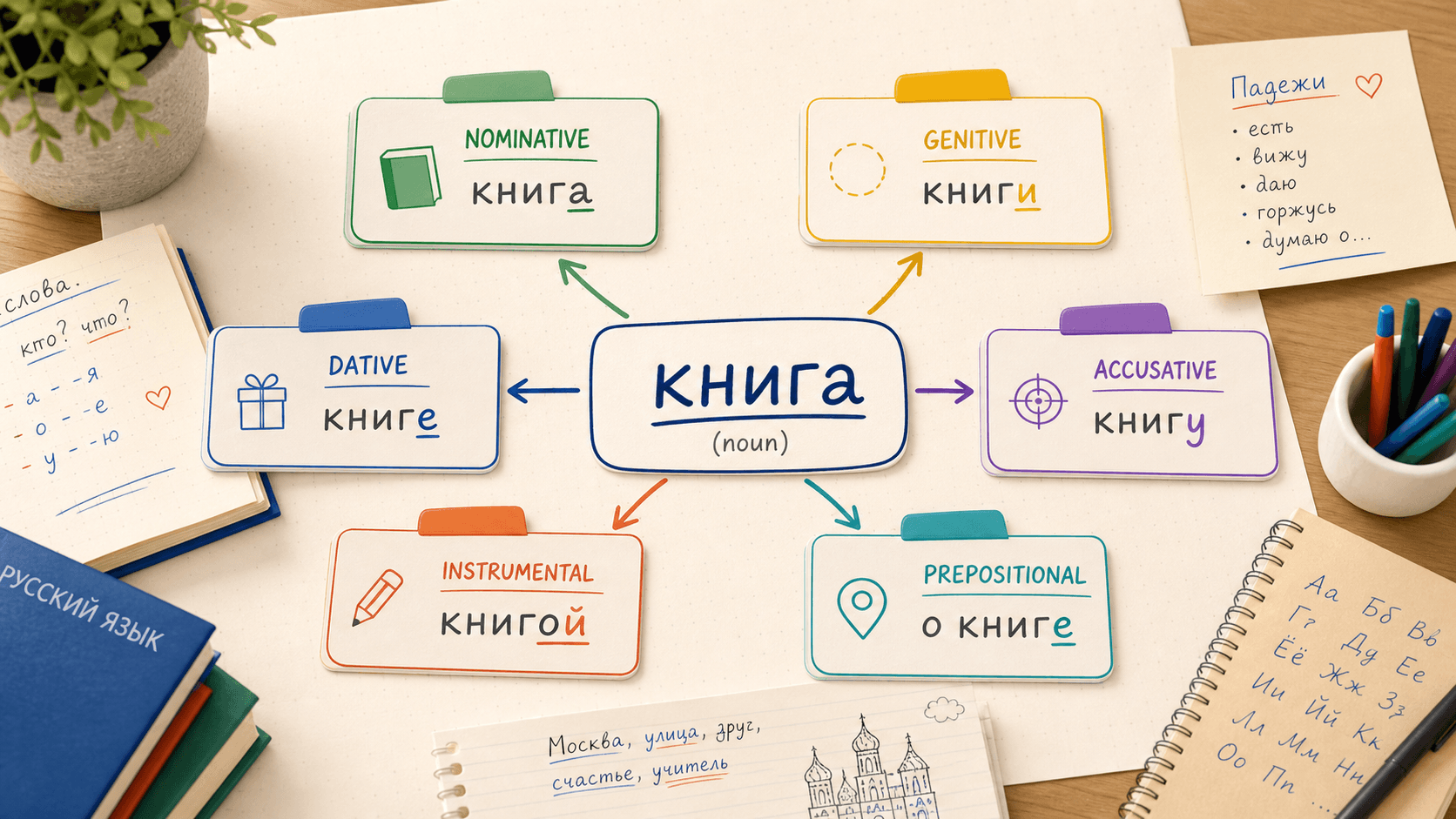
If you are reading this, you have probably heard the rumors. You might have been told that the Russian case system is an impossible mountain to climb, a chaotic maze of word endings, and the ultimate test of a language learner's willpower.
Take a deep breath. You can absolutely understand this.
Yes, Russian cases look terrifying when they are dumped onto a page in giant, intimidating tables. But the truth is, cases are not random. They are highly logical patterns that help you express exact relationships between words. Once you understand the why behind them, learning them becomes less about memorizing grids and more about recognizing familiar roles.
Welcome to the first explanation of Russian grammar for beginners that will finally make things click. Let's demystify how Russian cases work.
What Actually Is a Case?
Before we list them, we need to understand what a "case" actually does.
Think of a word as an actor in a play. Depending on the scene, that actor plays a different role: a hero, a bystander, a villain. To show the audience which role they are playing, the actor wears a different costume.
In language, a case is the costume a word wears to show its role in a sentence.
In English, we mostly rely on word order to tell us who is doing what.
- The dog bit the man. The dog is the attacker.
- The man bit the dog. The man is the attacker.
The words did not change, only their position did. But in Russian, word order is highly flexible. You can put the words in almost any order, and the sentence will still mean the same thing.
How? Because Russian changes the endings of the words to show who is the attacker and who is being attacked. When you change the ending of a noun to show its job, that is called declining a noun. That is the entire secret of the Russian case system: endings carry meaning.
Meet the Six Russian Cases
Instead of looking at all the possible endings at once, let's look at the meaning of each case. We will use the simple, friendly word Анна (Anna) to show how her "costume" changes depending on her job in the sentence.
1. The Nominative Case: The Subject
The main idea: This is the dictionary form of a word. It represents the main character of your sentence, the person or thing taking action.
Answers the question: Who? or What?
The transformation: Анна stays exactly as she is.
- Анна читает. (Anna chitayet.) - Anna is reading.
- Где Анна? (Gde Anna?) - Where is Anna?
2. The Accusative Case: The Direct Object
The main idea: This case is the target. It is the person or thing directly receiving the action of a verb. If you see, love, read, or hit something, that "something" is in the accusative case.
Answers the question: Whom? or What are you acting upon?
The transformation: Анна changes her ending to -у: Анну (Annu).
- Я вижу Анну. (Ya vizhu Annu.) - I see Anna.
- Иван любит Анну. (Ivan lyubit Annu.) - Ivan loves Anna.
Notice how the -у tells us Anna is the one being loved, no matter where her name is in the sentence.
3. The Genitive Case: Possession and Absence
The main idea: The genitive case is the glue that connects two nouns. It is the equivalent of the English words "of" or an apostrophe-s. It is also used to show that something is missing or absent.
Answers the question: Whose? or Of what?
The transformation: Анна changes her ending to -ы: Анны (Anny).
- Это книга Анны. (Eto kniga Anny.) - This is Anna's book. The book of Anna.
- Здесь нет Анны. (Zdes' net Anny.) - Anna is not here. There is an absence of Anna.
4. The Dative Case: The Receiver
The main idea: The dative case is all about giving, sending, or directing something toward someone. It translates nicely to the English concepts of "to" or "for."
Answers the question: To whom? or To what?
The transformation: Анна changes her ending to -е: Анне (Anne).
- Я даю подарок Анне. (Ya dayu podarok Anne.) - I am giving a gift to Anna.
- Я звоню Анне. (Ya zvonyu Anne.) - I am calling Anna.
5. The Instrumental Case: The Tool or Companion
The main idea: This case tells us how or with what an action is done. You use it for the instrument you are using, or the person you are doing an action with.
Answers the question: With whom? or By what means?
The transformation: Анна changes her ending to -ой after с: с Анной (s Annoy).
- Я иду в кино с Анной. (Ya idu v kino s Annoy.) - I am going to the movies with Anna.
- Я пишу ручкой. (Ya pishu ruchkoy.) - I am writing with a pen.
6. The Prepositional Case: Location and Topic
The main idea: This case is uniquely simple because it is only ever used after certain prepositions, like "in," "on," or "about." It points out locations or the subject of a thought or conversation.
Answers the question: About whom? or Where?
The transformation: Анна changes her ending to -е after об: об Анне (ob Anne).
Yes, it looks just like the dative, and that is okay. Context will tell you which is which.
- Мы говорим об Анне. (My govorim ob Anne.) - We are talking about Anna.
- Я живу в Москве. (Ya zhivu v Moskve.) - I live in Moscow.
Focus on Meaning, Not Memorization
When you see Russian cases explained simply, the underlying truth is always this: endings are just signals.
If you are a beginner, your instinct might be to find a master chart of every ending for masculine, feminine, neuter, and plural words, and drill them until your eyes blur. Please do not do this.
Brute-force memorization of abstract tables is exactly why Russian cases for beginners feel so intimidating. You do not need to memorize giant tables right now. You just need to know that if a word has changed, it changed for a specific, logical reason. Over time, through repeated exposure to these patterns, the forms will begin to sound correct to your ear.
How to Actually Learn Russian Cases
If staring at grammar charts does not work, what does?
- Learn in chunks, not single words: Do not just learn the word "Moscow" (Москва). Learn the phrase "I live in Moscow" (Я живу в Москве). You will naturally absorb the prepositional case without having to think about the rules.
- Prioritize exposure: Read simple texts and listen to beginner podcasts. You will hear the accusative case hundreds of times before you ever try to build it yourself. Your brain is a pattern-recognition machine; let it do its job.
- Practice with real sentences: When you learn a new verb, like "to read," immediately pair it with an accusative noun: Я читаю книгу (I read a book). By connecting the verb directly to its required case, you skip the mental gymnastics.
- Focus on one case at a time: Master how the accusative works before you worry about the instrumental. Give your brain time to digest.
Common Beginner Mistakes to Avoid
The path to speaking Russian is a journey. Be kind to yourself, and watch out for these common traps:
- Trying to memorize every ending at once: This leads directly to burnout. Learn cases one by one, slowly, as you need them.
- Translating word-for-word from English: English uses prepositions where Russian often uses cases. Trying to translate "of" or "to" directly every time will tie you in knots. Focus on the concept of the Russian case instead.
- Obsessing over exceptions: Yes, Russian has irregular words. Ignore them for now. Master the 90% of words that follow the standard patterns first.
- Panicking when speaking: When you are speaking and you use the wrong ending, people will still understand you. Using a nominative word instead of an accusative word makes you sound like a learner, not unintelligible. Speak first, refine later.
You Can Do This
The Russian case system is not a wall built to keep you out; it is a beautifully engineered framework that gives the language its rich, poetic flexibility.
You do not need to be a grammar genius to master it. You just need patience, a little bit of daily exposure, and the willingness to let your brain slowly map out the patterns. Every time you correctly say Я люблю тебя (I love you) or order a coffee with milk, с молоком, you are already successfully using cases.
Keep listening, keep practicing, and trust the process. You are well on your way.
If you want a more structured next step, continue with Slavonaut's interactive Russian cases lesson, which walks through each case with examples and practice.